Remedial Investigation/Feasibility Study (RI/FS) and post-RI/FS activities including site investigation and characterization, human health and ecological risk assessments, community involvement support, and technical support to develop Proposed Plans and Record of Decisions.
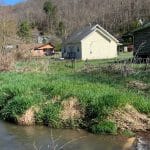
The Shaffer Equipment/Arbuckle Creek Area Superfund Site is located in Minden, West Virgina. The primary source area is the former Shaffer Equipment Company (SEC) Property, designated as Operable Unit 1 (OU1), and located within the 100-year floodplain of Arbuckle Creek.
The former SEC operated from approximately 1970 until 1983 manufacturing electrical substations for the local coal mining industry. The substations incorporated various types of transformers, capacitors, switches, and related voltage regulation and distribution devices that utilized cooling oil that contained polychlorinated biphenyls (PCBs). Mismanagement of these electrical devices by the SEC resulted in the release of PCB-containing oils to the environment. Adjacent and downgradient areas that have been impacted by releases of contamination from the former SEC Property includes a one-mile stretch of Arbuckle Creek and associated wetlands immediately downstream of the former SEC Property, and the next two miles of the Creek to its confluence with New River, which is part of the New River Gorge National Park and Preserve. Prior to the RI, several removal actions were undertaken by the USEPA between 1984 and 2020, including efforts to demolish the former SEC property infrastructure and consolidate PCB-contaminated soil under an impervious cap/barrier located on the property and adjacent to Arbuckle Creek.
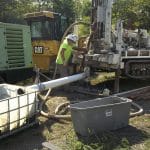
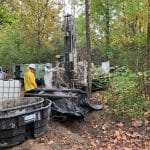
The RI included extensive site preparation for access and utility clearance and close coordination with the local sewer, gas, and water utility providers. Multi-media sampling of soil, sediment, surface water, groundwater, and indoor dust was performed to support site characterization and risk assessments. Field activities included: advancement of over 130 soil borings and collection of ~350 soil samples; installation of 11 bedrock wells using borehole geophysics combined with drilling observations to select screen intervals, and installation of two overburden wells followed by collection of four rounds of seasonally variable groundwater samples; collection of 74 co-located sediment samples/surface water samples; and collection of 130 soil samples from residential properties in addition to sampling indoor dust. The RI also included extensive background sampling to develop background threshold values and conduct statistical analysis of on-site versus background data.
An initial human health risk assessment (HHRA) was conducted for soil at the former SEC Property, which triggered a focused FS to address unacceptable risks and known concentrations of PCBs below the impervious cap/barrier of over 1,000 parts per million. An interim cleanup was established for OU1 ahead of selection of remedy for the rest of the site. The remaining areas of concern were addressed in a comprehensive HHRA for all media and ecological risks were evaluated in a screening-level ecological risk assessment. Unacceptable human health and ecological risks from PCBs and dioxins/furans were addressed in a FS. Nobis has provided support to USEPA for community involvement throughout the RI/FS process and to support proposed plans and record of decisions (RODs) for cleanup at the site.
challenges
- Phase 1 of the field investigations was completed under a prior contract by another contractor.
- Access to the investigation areas was limited due to the presence of extensive underground utilities (gas, water, and sewer [high-pressure and gravity systems]) and thick vegetation.
solutions
- Nobis successfully integrated another contractor’s data and findings with the results of the Phase 2 field investigations into combined chemical and GIS databases to develop a comprehensive RI report and risk assessments for the site.
- Nobis engaged in close communication with the local utilities to avoid damage or interruption of services for the local community via utility locating/marking and installation of protection systems over utility lines that could not be fully avoided. Nobis performed extensive site preparations to mitigate spatial data gaps via vegetation clearing and construction of a temporary bridge and access roads for heavy equipment.
results
Remedial decision-making was conducted in collaboration with the West Virginia Department of Environmental Protection and the town of Minden to ensure the protection of human health and the environment. The ROD for the former SEC Property (OU1) was finalized in 2024 and a ROD for the remainder of the site soil and sediment (a.k.a., OU2) is expected to be finalized in 2026.