




Strategically addressing spatial adjacencies and functionalities of multiple municipal departments while prioritizing energy efficiency.
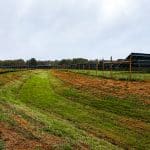
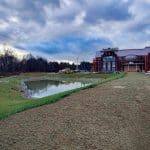
In need of housing several departments within Rockingham County under one roof, a 25-acre parcel was set aside for the development of a 110,000-sf municipal complex in Brentwood, NH. Set among sensitive wetlands home to threatened species and a profitable hay field for the County, careful consideration was required for the site and necessary infrastructure while prioritizing energy efficiency. With a focus on improving the health and safety of the community; reducing environmental and financial impacts for the County; and protecting the existing wetlands and threatened wildlife residing on the site, Nobis Group was hired by Rockingham County and Warrenstreet Architects provided full site-civil engineering, stormwater/wastewater design, and permitting services. The complex strategically addressed spatial adjacency & improved functionality for Sheriff’s Office, Emergency Operations and Dispatch Center, Department of Corrections, County Attorney, Registry of Deeds, and County Commissioners.
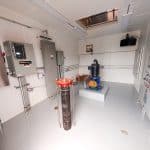
A new campus-wide water distribution system was required due to scaling and low water pressure in the existing system. The replacement had to maintain water service to adjacent facilities (a nursing home and corrections facility) without disturbing the North Road Right-of-Way (ROW). Additionally, one of the existing drinking water wells was contaminated by per-and polyfluoroalkyl substances (PFAS) and occupied developable acreage within the well protection radius. To minimize disruption during construction of the water distribution system replacement, phased design and implementation allowed existing infrastructure to maintain uninterrupted water service. Historical drawings, GIS data, and ground penetrating radar (GPR) were referenced, and directional borings at two strategic state highway crossings at North Road were employed to identify and reroute utilities without disturbing the recently paved roadway. Nobis also investigated, drilled, and permitted a new public water supply well for the complex, replacing the one contaminated by PFAS and freeing up space for future development.
To control stormwater runoff from the driveway, which could contaminate sensitive ecosystems, Nobis developed a stormwater runoff system that incorporated a single open wet detention basin for collection and treatment. Additionally, a proprietary engineered filtration unit was designed and implemented to treat stormwater runoff prior to discharging into sensitive wetland areas at the most challenging low point in the new driveway. To protect threatened species within the complex’s developable acreage and profitable hay fields, Nobis crafted a formal plan with the New Hampshire Department of Environmental Services (NHDES) Wetlands Bureau and New Hampshire Fish and Game (NHF&G). Time of year restrictions were imposed for mowing activities along with mower blade height requirements to prevent wildlife injury and mortality. Curbing was also implemented to facilitate movements of the Spotted Turtle, and stormwater catch basin grates were designed with sized openings to prevent capture and entrapment of turtle hatchlings. These safeguards allowed the County develop an acceptable site for the complex and maintain a profitable enterprise without negatively impacting wildlife. The acreage was also utilized for the 4.3-megawatt solar array, which was designed and permitted in concert with Revision Energy and Warrenstreet Architects. The solar array provides clean energy to power the complex without financial strain to the County, even occasionally providing surplus to the grid.
Finally, the team worked with the New Hampshire Department of Transportation (NHDOT) to consolidate and realign driveway access points. A circumferential ADA compliant roadway and sidewalks to all entrances and exits of the building were designed and constructed along with additional sidewalks featuring Rectangular Rapid Flashing Beacon (RRFB) crosswalks.
The work on the Rockingham County Municipal Complex showcases the ability for environmental and safety considerations to be accommodated in the face of several limiting factors thanks to thoughtful innovative plans and systems. Additionally, utilizing modern technologies, like GIS data and GPR, in conjunction with historic data, can prevent problems with underground utilities before they even begin.
challenges
- Design and implement new water-distribution system without disrupting service to existing users or impacting the North Road ROW.
- Subsurface stormwater controls were precluded due to relatively shallow depths of the seasonal high-water table.
- Siting of complex and solar array existed within habitats of threatened species.
solutions
- Leveraged historic plans alongside GIS and GPR data to verify plans, allowing accurate mapping.
- Implemented phased plan to minimize disruptions during water system replacement.
- Utilized a specially designed filtration unit for stormwater treatment.
- Collaborated with NHDES and NH F&G to develop species protection plan that allowed for development of complex and solar array without negatively impacting wildlife.
results
The complex, which opened November 7, 2025, was constructed to house many departments of the county requiring proximal access to one another and benefits financially from the hay fields – all without impacting threatened wildlife. It includes a new well and water distribution system that improves water quality for both the complex and neighboring community facilities and the solar array offsets their electrical usage and, at times, may provide surplus power to the grid. Additionally, access and safety to the site were improved for vehicles and pedestrians alike.