Geotechnical engineering services to support the MassDOT I-90/I-95 Interchange Rehabilitation Project
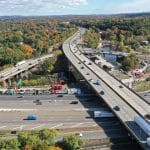
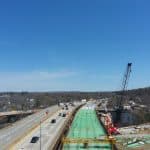
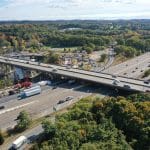
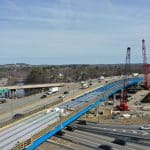
The project consists of the 1,030-foot-long 7-span I-90 bridge which crosses I-95 and the Charles River, I-90 bridge over Charles Street, I-90 bridge over MBTA/ CSX Railroad, and four (4) other bridges associated with the I-90 on-ramp from I-95 and associated highway and ramp realignments.
Nobis’ services included the implementation and observation of a subsurface exploration program as well as the oversight of the program, which included over 80 test borings, including NX rock coring, several tests pits, and eleven (11) seismic cone penetration tests (SCPTs). Twelve (12) of the borings were completed from a barge in the Charles River. SCPT data was useful to further evaluate subsurface conditions and determine material properties including a design strength envelope for the encountered sands and shear wave velocity determination for soil seismic analysis. Nobis completed a laboratory testing program which included sieves, uniaxial compressive strength of rock, corrosivity and four (4) triaxial and five (5) direct simple shear analyses. Nobis’ geotechnical design included:
- Analysis and evaluation of spread footings for selected piers including soil liquefaction relative to design seismic loadings, bearing capacity and total elastic settlement.
- Analysis and evaluation of earth retention structures including Mechanically Stabilized Earth (MSE) retaining wall recommendations and slope stability analysis using Slide 2018 and finite element software. This included a proposed 35-foot-tall MSE wall located at the top of a 30-foot-tall 2H:1V slope. Evaluation included feasibility design of temporary 30-foot-tall temporary Support of Excavation (SOE) wall required to construct the proposed MSE wall adjacent to the I-90 eastbound road.
- Evaluation of deep foundation systems for proposed bridge abutments to be located within MSE walls. Performed vertical and lateral pile capacity analysis including the use of LPILE v 2016 and RSPILE 2018. Pile driving feasibility was evaluated using GRLWEAP software.