Geotechnical engineering services in support of the Design-Build procured replacement of five MBTA railroad bridges.
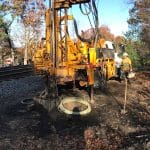
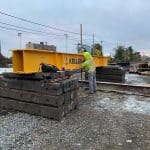
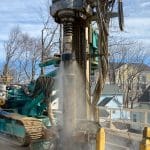
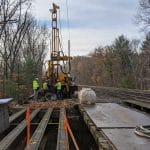
Existing bridges were built in the early 1900s, and replacement was necessary to bring them into a state-of-good repair. Nobis observed and logged the subsurface exploration programs, performed the soil and rock laboratory testing, performed the foundation analyses, and prepared a geotechnical report for each of the five bridges in support of the final design and construction documents. Four of the new bridges were supported on two or three rows of 9-5/8-inch diameter drilled micropiles installed behind the existing abutments. The Parker Street bridge in Lawrence was replaced with two separate single-span superstructures with each having two bays carrying two tracks. The new superstructures are supported by the existing abutments but were strengthened by installing one row of micropiles in front that were subsequently structurally connected to the existing abutments. Tiebacks were installed through the existing east abutment to resist additional lateral loads.
Nobis supported the development of the specifications for the drilled micropiles as well as for the tieback soil anchors. Nobis prepared Geotechnical Instrumentation and Monitoring Plans for each bridge which include recommendations for deformation monitoring points, crack gauges, and vibration monitoring.
During the construction, Nobis reviewed contractor submittals, observed the micropile verification and proof load tests at each bridge and the tieback performance and proof testing at the Parker Street bridge, and prepared observation field reports in support of the QA/QC of the project.
challenges
- Performing test borings and construction within an active rail corridor.
- Very tight schedule to perform the test borings, geotechnical analyses, and geotechnical reports.
solutions
- Extensive coordination between the design team and the contractor.
- Micropiles were installed during weekends
- Optimized pile layouts to reduce project costs.
results
Project received the Bronze Award for the 2026 ACEC/MA Engineering Excellence Awards Competition.